

British start-up's drone battery boosts range by 50%
Fri, 31st Jul 2026.webp)
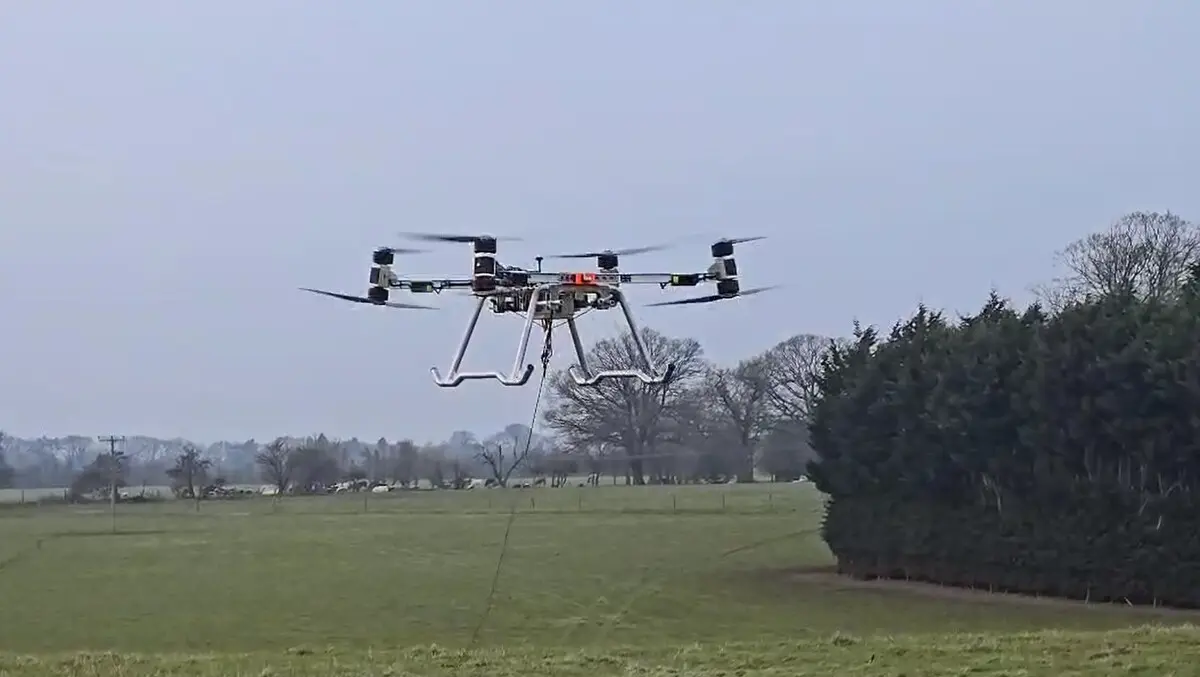
The Structural Battery Company has developed Drone Spine, a battery system that forms part of a heavy-lift drone's frame. The British start-up says the design can increase range and payload by up to 50%.
The system combines energy storage with the aircraft structure, replacing a separate battery unit with crossbeams that also support the airframe. The company says this cuts weight and frees internal space for payload or propulsion.
A demonstration with ISS Aerospace and Marshall Aerospace tested the design on a 600kg heavy-lift drone using a 400-volt structural battery. According to the company, the aircraft's mass fell by 45%, allowing it to carry a 220kg payload over more than 100 kilometres.
The development is aimed at sectors where drone range and carrying capacity can limit operations, including emergency medical work, wildfire response, agriculture, military logistics and small satellites.
Wildfire focus
The company pointed to wildfire response as an immediate use case as large fires continue to affect parts of Europe, Canada and the UK. In that setting, a heavier payload and longer range could allow drones to deliver more fire retardant to remote sites and spend less time returning for recharging.
That could matter most in the early stages of a blaze, when response times are short and access can be difficult for ground crews or manned aircraft. A drone able to make repeated retardant drops without the same logistical burden as conventional aircraft could help contain smaller fires before they spread, the company says.
John Moffat, Chief Executive Officer of The Structural Battery Company, set out that case in comments on the product. "The real-life benefits of this are transformative, not least in fighting the kind of wildfires we're seeing ravaging France, Spain and Canada, as well as some now here in the UK," Moffat said.
Medical and defence uses
The company also sees use cases in emergency medicine, particularly in hard-to-reach areas where roads are damaged or terrain slows conventional transport. In those situations, heavy-lift drones could carry blood, defibrillators and other medical equipment directly to responders.
"Our Drone Spine innovation will save lives by enabling medical supplies to get to critically ill or injured patients in remote locations far quicker than ever before. It will dramatically improve firefighters' ability to extinguish wildfires by enabling drones to carry more flame-retardant materials further and to make more trips between battery recharges. In future, we will see many more applications that perhaps none of us have even thought of yet.
With drones increasingly becoming a core component of modern warfare, armed forces equipped with longer-range, heavier-payload uncrewed systems raise the cost of conflict for potential adversaries before a shot is fired, hopefully making wars less likely. Heavy-lift drones with improved battery capability could also be used by armed forces to deliver humanitarian aid and frontline supplies, as well as many other things we haven't yet even thought of," Moffat said.
Military applications are part of a wider push to improve the endurance and lifting ability of uncrewed systems. In recent conflicts, drones have taken on a larger role in surveillance, supply and attack missions, increasing demand for designs that can carry more equipment over longer distances.
Design challenge
Battery weight has long been one of the main technical constraints in unmanned aviation, especially for larger aircraft that must balance lift, endurance and payload. Conventional drone designs treat batteries as discrete units that add weight without contributing to the aircraft's structure.
Drone Spine is intended to address that by making the battery part of the frame. The company says this simplifies one of the more difficult parts of drone development by combining structural and electrical functions in a single component.
The architecture is suited to quadcopter UAVs with a maximum take-off weight of up to 600kg and a payload-to-drone ratio of 4:1, according to the company. That places the design at the heavier end of the commercial and defence drone market, where operators are seeking aircraft that can move meaningful loads rather than perform light inspection or photography work.
Outside aviation, the same concept could be applied to small satellites, where structural panels or chassis components could also store energy. In space systems, reducing the mass allocated to separate power units can free up weight for instruments or other mission equipment.
In agriculture, the appeal is more operational. Heavy-lift drones with greater range could cover larger areas when spraying, seeding or collecting data, reducing the number of return trips needed for charging and potentially making autonomous fieldwork more practical at scale.
The test data provide an early proof point as the company seeks to show that structural batteries can move beyond laboratory concepts into working aircraft. In the demonstration, the 600kg drone carried a 220kg load for more than 100 kilometres.