

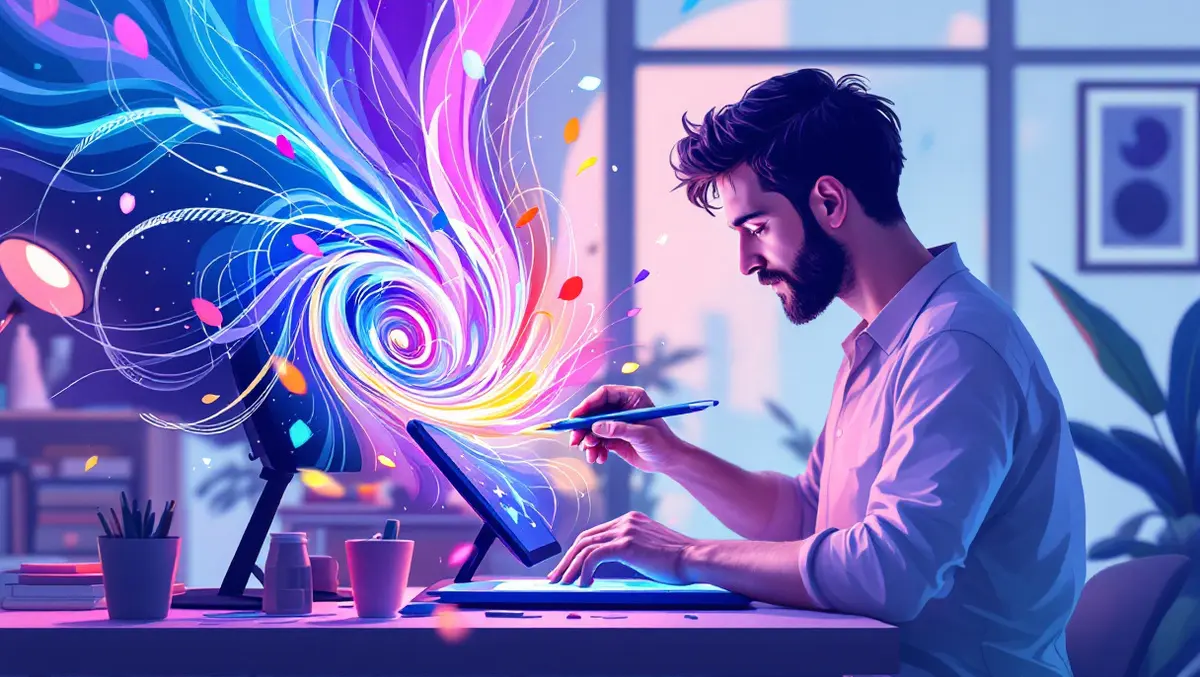
Quantum Brush brings real quantum computing to digital painting
Wed, 10th Sep 2025
MOTH has introduced Quantum Brush, an open-source digital painting tool that applies quantum computing principles to digital art creation.
Quantum Brush translates an artist's brushstrokes into quantum algorithms, giving rise to digital artworks directly influenced by phenomena such as superposition, entanglement, and quantum measurement. The tool has undergone testing on quantum hardware, including the IQM Sirius device, which brings authentic quantum "noise" to the final artworks.
Quantum mechanics in art
Quantum Brush operates by embedding the mathematics of quantum physics into the act of digital painting. Artists can make use of the tool without familiarity with quantum mechanics. Joao Ferreira, Researcher at MOTH, stated,
"Quantum Brush is about making the invisible visible. Artists don't need to know quantum mechanics to use it. With each stroke, they're collaborating with the strange and beautiful mathematics of the quantum world."
The central question framing the development of the tool is whether there can be such a thing as a quantum aesthetic for digital art. Throughout the history of art and technology, new mediums have opened up fresh possibilities for artistic expression, and MOTH positions Quantum Brush as the next step in this progression.
Initial features
The initial release of Quantum Brush offers four digital brushes, each reflecting a distinct behaviour informed by quantum theory. The "Aquarela" brush blends colours in a manner similar to watercolours, utilising quantum entanglement so that the brush and canvas interact unpredictably.
The "Heisenbrush" generates dynamic patterns by representing quantum time evolution through shifting colours and forms. The "Smudge" brush focuses on quantum information erasure, creating entangled colours as the brushstrokes are dragged across the digital canvas.
The "Collage" brush is inspired by the no-cloning theorem, enabling partial copying of image regions where the fidelity between the original and the duplicate must be balanced. MOTH reports that testing these brushes on IQM's Sirius quantum device introduces hardware-specific quantum noise that classical computers cannot replicate.
Access and approach
Quantum Brush is designed to mirror the workflow of familiar digital art software, allowing artists to import images, select brushes, and paint. The innovation lies in the backend, where quantum algorithms process each brushstroke before being mapped to the canvas. The application is open-source and extensible, with MOTH inviting developers and artists to contribute their own brushes, effects, and algorithms to help evolve the creative toolset.
Early artistic collaboration
Berlin-based artist Roman Lipski, an early participant in the project, described his experience of using Quantum Brush as markedly different from traditional digital painting tools. According to Lipski,
"Working with Quantum Brush is "a dialogue with the tool." Unlike traditional techniques, quantum-driven brushes introduce unfamiliar behaviours, pushing artists toward new aesthetic directions."
MOTH sees the project as a first step toward more specialised quantum-native creative tools. The company believes that, beyond digital painting, quantum-driven software may find future applications in fields ranging from visual effects to generative media.
Community and future development
MOTH has released Quantum Brush as a free, open-source application, reflecting an intent to cultivate a broad user base that includes artists, designers, and software developers. By making the platform extensible, MOTH encourages experimentation and the creation of additional quantum-inspired brushes and effects. The collaboration with artists in the development phase suggests that the company aims to integrate practical artistic feedback into ongoing and future updates.
MOTH is headquartered in London with an R&D office in Basel. The development and release of Quantum Brush signal the company's commitment to exploring quantum computing applications within the creative industries.