

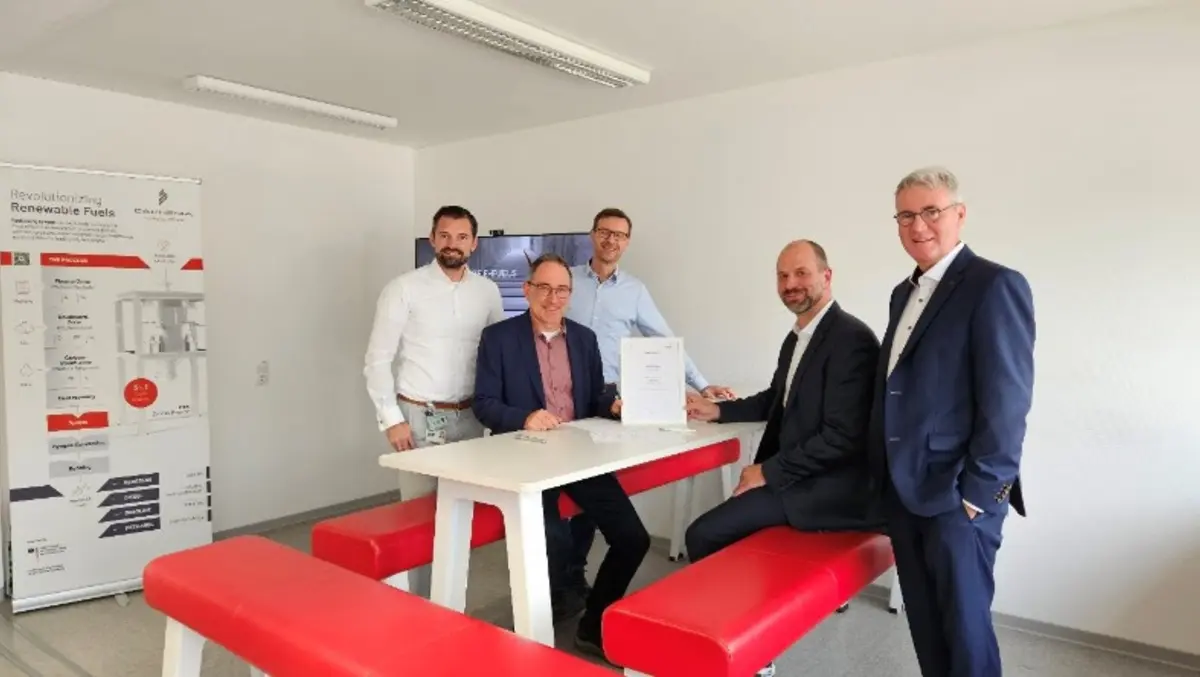
Siemens backs CAPHENIA to scale synthetic aviation fuel
Thu, 26th Feb 2026
Siemens has partnered with German cleantech company CAPHENIA on industrial automation and digitalisation for synthetic fuel production, with the aim of scaling Sustainable Aviation Fuel (SAF) output from pilot to commercial plants.
Under the agreement, Siemens becomes CAPHENIA's preferred partner for automation and digital systems for CAPHENIA's plasma-based process, which converts bio-methane into synthesis gas. That synthesis gas can then be upgraded into SAF, renewable diesel, or chemical products.
SAF is a synthetic kerosene made from renewable feedstocks. The companies say it can cut CO2 emissions by up to 80 percent compared with fossil kerosene.
Plasma process
CAPHENIA's process uses plasma to split bio-methane into synthesis gas at around 1,500 degrees Celsius. The core unit is the Plasma Boudouard Reactor, described as a three-zone reactor that integrates three established chemical reactions in one system.
CAPHENIA says the process produces synthesis gas without by-products and with minimal energy losses. It also emphasises heat management: heat released when cooling the synthesis gas is used to preheat incoming bio-methane.
According to CAPHENIA, this heat integration lifts process efficiency to more than 86 percent, which it positions as higher than conventional methods for producing synthesis gas from similar feedstocks.
Standardised template
The partnership focuses on developing a standardised approach to automating and digitally modelling CAPHENIA plants. Siemens will provide systems and software from its Siemens Xcelerator portfolio, including process control systems, drives, measurement technology, and process simulation software.
A key element is the use of digital twins. The companies plan to use these models to optimise operating parameters before commissioning a physical facility, while keeping processes consistent across sites as CAPHENIA moves to multi-plant deployment.
Siemens will support CAPHENIA from its pilot plant at the Höchst industrial park near Frankfurt through to commercial scale-up. CAPHENIA says its "Germany I" pilot plant at Höchst is due to begin operating in 2026 and demonstrate the technology at industrial scale.
The companies also plan a modular approach for future deployments. The automation and digitalisation template for the Plasma Boudouard Reactor is intended to scale modularly and be adapted for different locations.
Siemens expects a standardised template to shorten commissioning timelines and accelerate new plant roll-outs in the coming years. The deal comes as the market shifts quickly from demonstration projects to industrial production volumes, driven by policy and airline decarbonisation commitments.
Market pressure
SAF demand is rising as regulators introduce blending requirements and penalties for non-compliance. In Europe, the EU Renewable Energy Directive sets binding quotas for renewable fuels.
The companies point to a wide gap between expected demand and current supply. They estimate the global aviation industry will need around 500 million tonnes of SAF a year by 2050, while SAF currently accounts for less than 1 percent of global kerosene demand.
Scaling production remains a central challenge, particularly for synthetic pathways that depend on access to renewable electricity and low-carbon feedstocks. CAPHENIA uses bio-methane to generate synthesis gas, a common intermediate in synthetic fuel production.
Christian Gückel, Head of Vertical Chemicals at Siemens Digital Industries, linked the partnership to aviation decarbonisation and capacity constraints.
"Decarbonizing aviation cannot be achieved without synthetic fuels. Demand for SAF is growing exponentially, yet production capacity urgently needs to be ramped up," said Christian Gückel, Head of Vertical Chemicals at Siemens Digital Industries, Siemens.
Dr. Mark Misselhorn, Founder and CEO of CAPHENIA, described the agreement as part of a competitive scaling race in a market he expects to develop unevenly across regions.
"This partnership shows how technology leaders are working together to drive forward the energy transition. Siemens brings the portfolio and expertise to standardize and digitalize our plants. But the real point is this: the market for sustainable aviation fuels will not grow evenly-it will fragment. Those who scale quickly, those who are industrial-ready, those who have the right partners will lead. Together, we are not only laying the foundation for the international ramp-up of our PBR technology - we want to lead it," said Dr. Mark Misselhorn, Founder and CEO, CAPHENIA.
Work under the agreement will focus on plant engineering standards, control systems integration, and repeatable digital models that can be reused across projects as CAPHENIA moves from a single pilot plant to multiple commercial installations.