

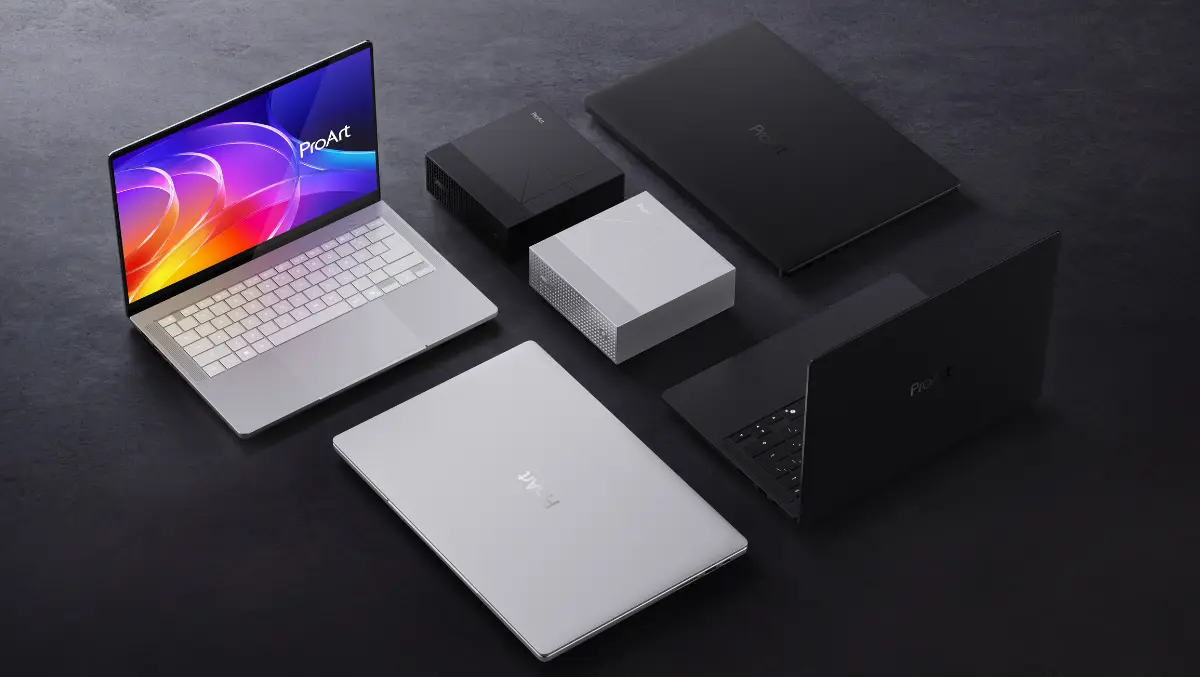

ASUS has launched a new range of ProArt creator PCs built on NVIDIA RTX Spark. The line-up includes two laptops and a mini PC.
The products target creative professionals, developers, and users running artificial intelligence workloads on local devices rather than cloud-based systems.
The new machines are the ProArt P16 and ProArt P14 laptops, along with a ProArt Mini PC. They form part of the ProArt range for content creation and are built around NVIDIA's RTX Spark, which combines an NVIDIA Blackwell RTX GPU with a 20-core NVIDIA Grace CPU.
ASUS is positioning the launch around the growing use of local AI tools for media production, software development, and agent-based computing. The systems support workloads including large 3D scene rendering, 12K 4:2:2 video editing, 4K AI video generation, and large language models with up to 1 million tokens of context.
Product range
The ProArt P16 and P14 are slim Windows laptops with ASUS Lumina Pro OLED displays. The P16 supports up to 4K 120Hz visuals with NVIDIA G-Sync, while the P14 offers up to 3K resolution.
Both laptops come in Nano Black and Neo White finishes. This generation is thinner and lighter than the previous ProArt P16 model, with an updated chassis designed for mobile creative work.
ASUS also introduced the ProArt Mini PC, a compact desktop system with a 150 x 150 x 51 mm chassis. The device is aimed at creators and developers that need substantial AI processing in smaller studio or workstation setups.
Across the line-up, RTX Spark delivers up to 1 petaflop of AI compute and up to 128GB of unified memory. That memory design is intended to help manage demanding on-device AI tasks and large models.
Local AI focus
The launch reflects a wider industry push to move more AI processing onto user devices. For some workloads, that can reduce dependence on remote data centres while giving users more direct control over latency, data handling, and workflow integration.
The new ProArt systems are designed for personal AI agents and local generative AI use. ASUS also highlighted software integration across its creator tools, including ProArt Creator Hub, MuseTree, and StoryCube.
Those applications are intended to manage system resources and support AI-assisted creative work. The ecosystem is also optimised for a broad range of software used in design, video editing, 3D rendering, and generative AI, including products from Adobe, Blackmagic Design, Blender, CapCut, ComfyUI, and OTOY.
Adobe features prominently in the software strategy. ASUS said Adobe is reworking Photoshop and Premiere for RTX Spark, and buyers of the new ProArt devices will receive a three-month Adobe Creative Cloud subscription.
Hardware details
NVIDIA's RTX Spark is central to the announcement. ASUS said the chip includes 6,144 CUDA cores and fifth-generation Tensor Cores with FP4 precision, linked through NVIDIA NVLink-C2C between the GPU and CPU.
For laptops, ASUS paired that architecture with OLED screens offering Delta E < 1 colour accuracy and brightness of up to 1,600 nits. The displays are designed for professional editing and rendering work, and the machines also include features such as haptic touchpad feedback and batteries of up to 99.9Wh.
The Mini PC adds connectivity aimed at professional use, including 10GbE wired networking and M.2 PCIe Gen 5 x4 expansion. ASUS said the system has thermal headroom of up to 140W to support sustained processing during intensive AI and rendering tasks.
Broader ecosystem
The release also extends the wider ProArt portfolio, which already spans displays, motherboards, chassis, and peripherals. By adding new laptop colours and a mini PC line, ASUS is broadening the visual and hardware identity of the range while linking the devices more closely to its in-house software tools.
That matters because creative hardware suppliers are increasingly trying to tie devices, displays, software, and subscriptions into unified workflows. ASUS is pursuing that strategy in a market where workstation makers, PC brands, and chip companies are all competing to define how AI is used in professional content creation.
NVIDIA's role is also significant. ASUS described the machines as the first Windows PCs built for personal agents around RTX Spark, underlining how chip suppliers are pushing PC manufacturers to make AI processing a clearer part of product design and marketing.
Availability will begin in select regions later this year, with further details on specifications and configurations still to come. ASUS said the new systems are intended to support creator workflows from ideation and content creation through to rendering and production.