

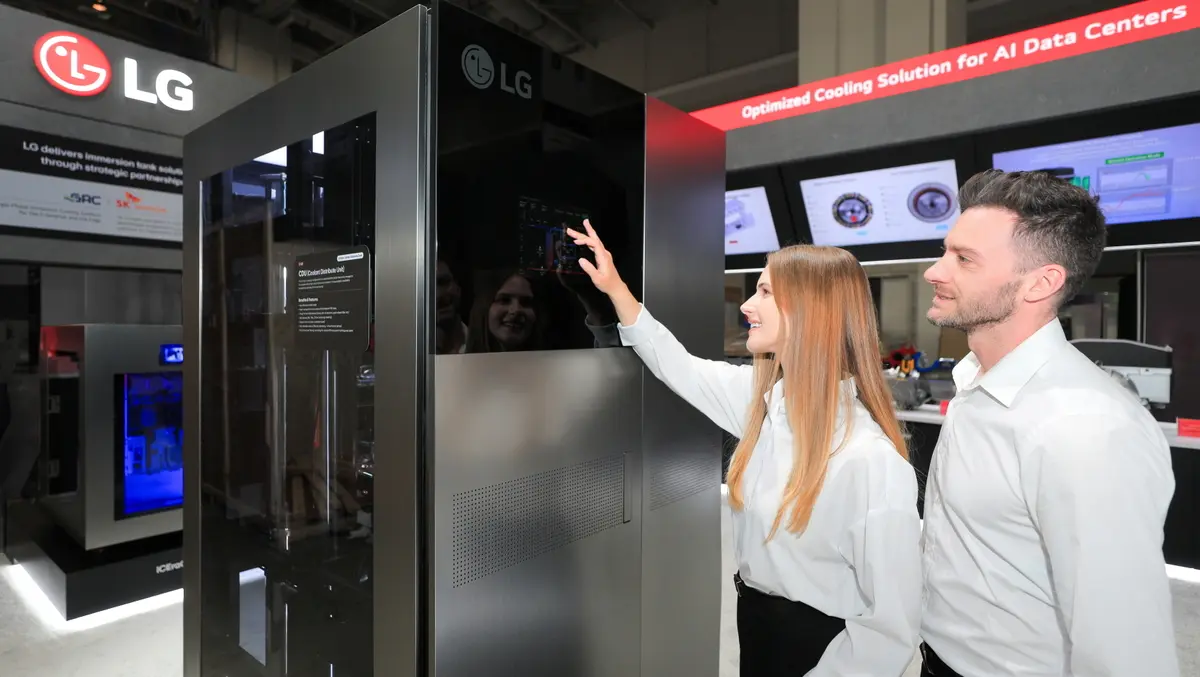

LG Electronics has received NVIDIA AI Factory validation for its 600kW Coolant Distribution Unit, making it an officially validated partner in this part of NVIDIA's AI infrastructure ecosystem.
The validation covers a cooling system for AI data centres, where operators are managing rising heat loads from densely packed GPU and CPU deployments. LG said the unit passed more than 100 technical evaluation criteria assessing cooling performance, reliability and failover requirements under AI Factory standardisation.
The approval places the South Korean electronics group among a relatively small number of suppliers to complete NVIDIA's technical verification process for this type of infrastructure. For data centre operators, it provides another pre-validated option when selecting liquid cooling systems for AI server deployments.
Liquid cooling has become central to AI data centre design as newer processors generate more heat than traditional air-based systems can efficiently handle alone. Coolant Distribution Units, or CDUs, form part of the cooling chain by circulating and controlling liquid that carries heat away from computing components.
LG's validated product uses a direct-to-chip liquid cooling approach, in which coolant is delivered directly to components such as GPUs and CPUs. According to the company, this allows the CDU to operate in a hybrid system alongside existing air-cooling infrastructure rather than requiring a separate setup.
According to LG, the unit is designed to deliver temperature control precision of plus or minus 0.25C and includes virtual sensor technology for real-time monitoring and leak detection. The CDU can also be paired with the company's Data Centre Cooling Control Manager for predictive control, centralised monitoring and integration with broader data centre management systems through standard communication protocols.
Broader push
The certification is part of LG's broader push into AI infrastructure and data centre cooling. The company intends to seek the same NVIDIA validation for higher-capacity CDU models, including 1MW, 2.5MW and 4MW systems, extending beyond the 600kW unit now approved.
The strategy reflects a wider market shift as equipment vendors seek a larger role in the physical infrastructure needed to support AI computing growth. While chipmakers and cloud groups draw most attention, demand has also risen for supporting systems such as chillers, pumps, cold plates and liquid distribution equipment.
LG is positioning itself around what it describes as a chip-to-chiller offering. That includes chillers that generate chilled water, CDUs that distribute coolant and cold plates that transfer heat directly from processors, giving the company a larger share of AI data centre cooling projects.
LG tests these systems at a dedicated validation site in Pyeongtaek, where it evaluates transient system responses, temperature changes and low-load stability across the cooling chain. It added that the CDU was engineered to meet NVIDIA's failover requirements so operations remain stable under demanding conditions.
Data centre market
Competition in AI data centre cooling has intensified as operators race to build capacity without compromising uptime. The market has drawn established HVAC manufacturers, specialist liquid cooling companies and infrastructure suppliers seeking long-term contracts with hyperscalers and colocation operators.
LG said it has recently won data centre cooling work, including hyperscaler facilities in North America and the Sinar Mas data centre, SM+ Data Centre's AI-ready site in Jakarta. Those project references suggest the company is moving beyond pilot work and into commercial deployments in regions where AI infrastructure investment is rising.
The cooling business also builds on LG's manufacturing base in HVAC equipment and core components. The company produces key parts in-house, including inverter systems and magnetic bearing compressors, which are used across its chiller range and support its wider cooling portfolio.
For customers, NVIDIA validation can serve as a procurement filter in a market where reliability standards are under close scrutiny. Operators building AI facilities must balance energy use, thermal performance, maintenance risks and deployment times, making pre-approved components attractive as projects are rolled out at scale.
James Lee, President of the LG ES Company, set out the company's view of that demand. "As AI data centres continue to scale, the need for highly reliable liquid cooling solutions has never been greater," Lee said. "Leveraging our advanced cooling technologies together with the LG Group's integrated infrastructure capabilities, we are expanding our AI infrastructure business with end-to-end solutions that help enable Physical AI, where AI creates value in real-world environments."