

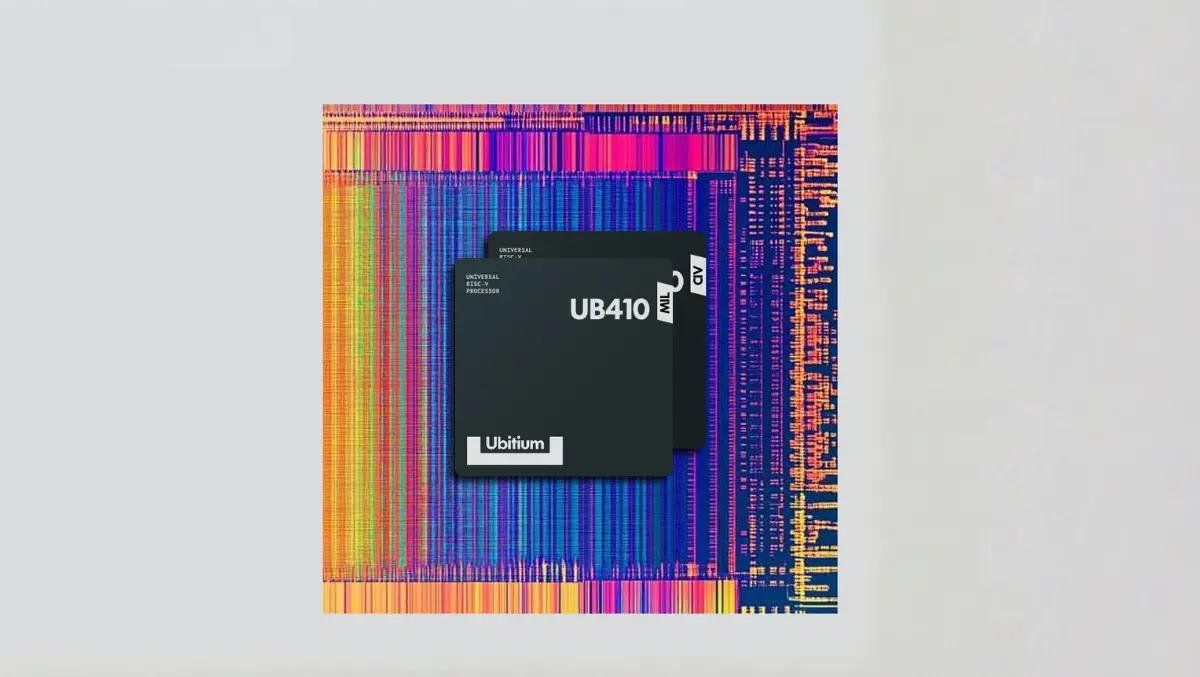
Ubitium unveils universal RISC-V chip for embedded systems
Mon, 9th Mar 2026.webp)
Ubitium has completed the first silicon tape-out of its universal microprocessor architecture on Samsung Foundry's 8nm process, as the German start-up makes its case for consolidating the growing number of processors inside embedded systems.
The tape-out was completed in December 2025. Ubitium describes the chip as a universal RISC-V processor designed to replace the multiple specialised processors commonly combined in modern embedded designs.
Embedded computing spans automotive electronics, industrial systems, consumer devices, robotics and defence applications. Ubitium puts the market at $115 billion and argues that system complexity-not raw performance-has become the limiting factor as more workloads move onto connected devices and machinery.
Automotive highlights the challenge. Ubitium says cars once relied on a single processor, while current vehicles can contain more than 200. Each chip can bring its own development tools, software stacks and supply chain relationships.
The design builds on the open-source RISC-V instruction set architecture and maintains full RISC-V software compatibility. Ubitium positions it as more than a conventional CPU, aiming to cover a wider range of embedded workloads on one piece of silicon.
One chip
Ubitium says its universal processor can run Linux and a real-time operating system simultaneously. It also says the chip can process radar and audio signals in real time and run neural networks for edge inference.
These workloads are intended to run without separate accelerators or coprocessors. Ubitium says the architecture is built around a "Universal Processing Array" that can reconfigure at runtime, enabling execution modes associated with CPUs, digital signal processing, graphics-style processing and parallel acceleration.
"This tape-out turns a long-held thesis into silicon," said Martin Vorbach, CTO of Ubitium. "Embedded workloads have outgrown the architectures the industry relies on today. Consolidation isn't optional anymore. It's inevitable."
Ubitium compared its approach to software-defined radio, where reconfigurable processing reduced reliance on fixed-function hardware. It argues that a single processor and toolchain could simplify system design, supplier management and qualification over long product lifecycles.
Foundry partners
The tape-out used Samsung Foundry's 8nm process technology. Samsung Electronics said it manufactured Ubitium's first silicon and described the project as part of a shift in embedded design toward reconfigurable compute.
"The shift toward software-defined, reconfigurable compute is accelerating. Ubitium's approach, one universal processor replacing multiple specialized chips, aligns with where we see embedded systems heading. We're proud to manufacture their first silicon," said Taejoong Song, vice president and head of the Foundry Technology Planning Team at Samsung Electronics.
Ubitium also named Siemens Digital Industries Software and ADTechnology as contributors. It said it used Siemens electronic design automation tools, including Veloce CS, a hardware-assisted verification and validation system.
"Shift-left verification helps teams validate system behavior earlier by running more realistic workloads ahead of first silicon," said Jean-Marie Brunet, senior vice president of Hardware Assisted Verification at Siemens Digital Industries Software. "Ubitium's use of Siemens' EDA tools, specifically the Veloce CS hardware-assisted verification and validation system, highlights how early validation can de-risk integration, support design closure, and accelerate time to first silicon."
ADTechnology, which provides design services for advanced process nodes, said it supported the implementation through timing, power and sign-off steps ahead of tape-out.
"Advanced-node silicon delivery depends on disciplined back-end execution across timing, power, and signoff," said Jun-Kyu Park, CEO of ADTechnology. "We are pleased to have supported Ubitium throughout the implementation process as it progressed to tape-out on Samsung Foundry's 8nm process."
Roadmap
Ubitium said the first tape-out validates foundational blocks of its architecture, including the Universal Processing Array and an LPDDR5 memory interface. It is targeting applications such as radar and multi-sensor signal chains, real-time audio and voice, computer vision, edge AI, automotive cockpits and industrial human-machine interfaces.
The founders and core engineering team have experience at Intel, Texas Instruments, Apple and Nvidia. Ubitium also said Vorbach previously created a reconfigurable processor called PACT XPP and holds more than 200 processor-architecture patents.
A second tape-out is expected later this year, with volume production targeted for 2027.