

Callosum raises $10.25m for mixed-chip AI architectures

Callosum has raised $10.25 million in a funding round led by Plural, with participation from the UK's Advanced Research and Invention Agency (ARIA). The London-based company is developing software to run AI systems across mixed chip architectures.
The round also included angel investors Charlie Songhurst, Stan Boland and John Lazar. The funding will support team expansion, software scaling and additional compute resources. Callosum is also working on a sovereign data centre built around mixed-chip infrastructure.
Callosum builds systems-level software that coordinates multiple AI models across different chip types. It positions the approach as an alternative to AI stacks optimised for a single dominant processor family.
Mixed-Chip Approach
Many AI deployments have focused on scaling single models across large numbers of identical accelerators. This has driven demand for high-volume GPU clusters and tightly integrated software stacks tuned to specific hardware.
Callosum argues that real-world workloads require different types of decisions and compute profiles. Its software is designed to schedule and run components of an AI system across heterogeneous hardware. The company says the approach is inspired by biological brains, which rely on varied structures rather than repeated identical units.
In materials released with the funding announcement, Callosum said its technology delivers "2x more accuracy", "7x faster performance" and "4x lower cost" than "monoculture solutions" on complex tasks such as autonomous computer use. It did not provide a technical breakdown of the benchmark set-up in the information released.
Founders And Background
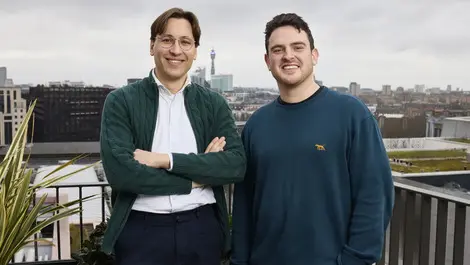
Callosum was founded by Danyal Akarca and Jascha Achterberg, who met while studying for PhDs at Cambridge across neuroscience, computing and AI. Their research has been published in Nature journals, and they have worked at Intel and collaborated with Google DeepMind, according to the company.
In a market where AI infrastructure is often shaped by scarce hardware, Callosum is also pitching its work as a supply-side shift. It says heterogeneous compute enables a wider range of processors to be used in production, including chips from newer providers seeking routes into data centres.
Customers And Partners
Callosum is targeting two customer groups: companies building multi-agent AI systems that want higher performance from systems made up of multiple models, and chip manufacturers seeking to demonstrate their hardware at scale in real workloads.
It says it already works with several cloud partners, including AWS, Google and Microsoft. The company has also secured ARIA support related to data centres using mixed-chip infrastructure, linking the work to UK efforts around AI sovereignty.
Alongside these cloud relationships, Callosum is planning sovereign AI infrastructure built around mixed-chip data centre design. It did not disclose the location, capacity or build partners in the information released.
Investor View
Akarca set out the company's view of current large-model strategies.
"Big labs are currently betting that one model will rule them all. We think that's wrong and our work proves this. Nature shows that real intelligence emerges from many systems working together. We've brought together incredible talent to enable a paradigm shift in how we build intelligent systems to solve real-world problems, with the infrastructure to make that possible, on any chip, anywhere in the world," said Danyal Akarca, Co-Founder, Callosum.
Achterberg said the company sees hardware diversity as a performance lever rather than a constraint.
"Everyone assumed chip diversity was a disadvantage to be managed. We saw the opposite, that it's an advantage to be exploited. We're not optimising one algorithm on top of the existing stack. We're using software to control all the levers across the entire system, extracting benefits from diversity that others dismiss. Plural understands this mission and we're excited to build alongside them," said Jascha Achterberg, Co-Founder, Callosum.
Plural partner Ian Hogarth pointed to the founders' research background and prior experience as part of the investment case.
"Danyal and Jascha have been published in several Nature journals and worked with some of the most prestigious AI and compute organisations in the world. Now they've built an incredible team to define and commercialise entirely new ground. Their vision for a multi-model, multi-chip future could be transformative and positions them to compete with the world's biggest chip and model makers. These are serious founders tackling a serious mission, which is exactly what we look for at Plural," said Ian Hogarth, Partner, Plural.
With the new funding, Callosum plans to expand its software and secure additional compute resources, while continuing work on mixed-chip data centre infrastructure in the UK.