

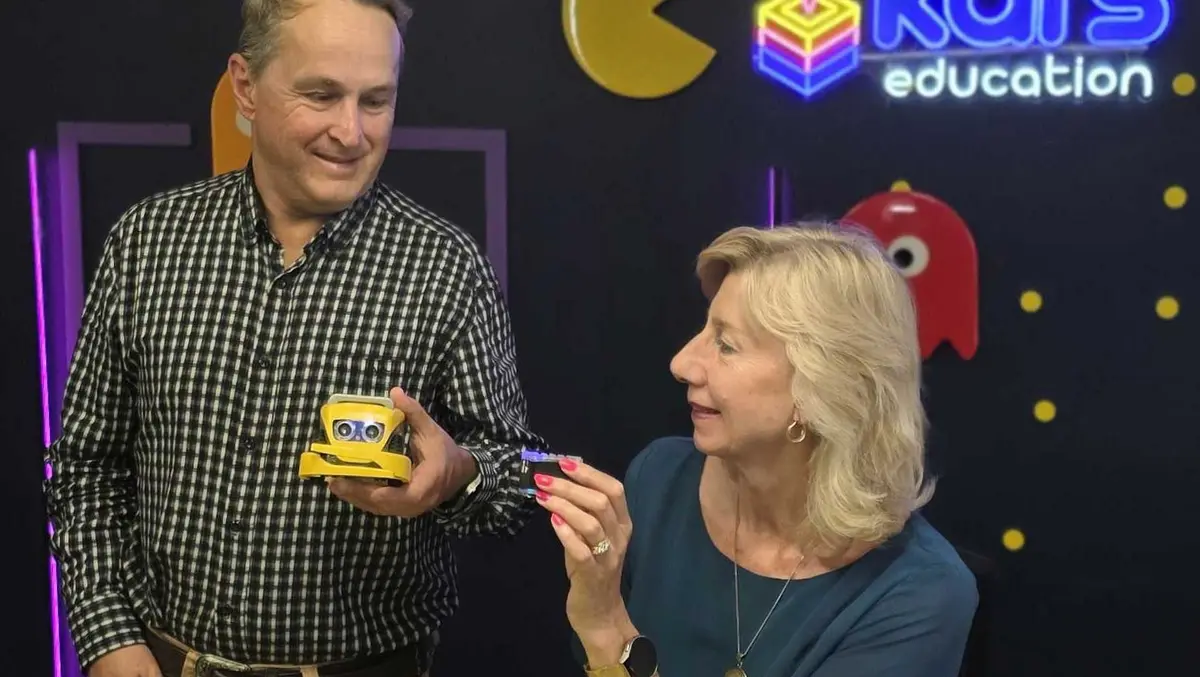

Kai's Education is promoting a screen-free approach to introductory coding lessons for younger children, arguing it can also support more inclusive classroom participation.
In an opinion piece, Co-Founder and Chief Executive Officer Ronel Schodt said the New Zealand education technology business believes children can start learning computational thinking without individual devices. Instead, they can work with a small programmable robot, coding cards and floor mats.
Schodt described a classroom exercise in which two children guide a robot to the final tile on a mat and ensure it finishes facing a particular direction. She said the task encourages pupils to predict outcomes, test a sequence of instructions and review errors together.
"I favor a screen-free start for younger learners," Schodt said.
Her comments come as schools in several markets reassess the balance between digital teaching tools and limits on screen exposure for younger pupils. Schodt pointed to plans in New South Wales to introduce screen time recommendations for public schools in 2027, including an average of 15 minutes a day on individual devices for children in Kindergarten to Year 2.
She said that limit should still leave room for digital tools when they serve a clear purpose for pupils who need support. "A tablet that lets a child tell a classmate where the robot went wrong has earned its place on the table," Schodt said.
For older pupils, devices can be introduced once a lesson has established a specific question, she said, such as identifying the line of Python code that controls a robot's turn. In that setting, students can compare screen-based code with physical instruction cards and test online tutorials in practice to judge how reliable they are.
Schodt also set out a broader view of how schools should assess digital learning resources. Rather than focusing on activity-completion dashboards, teachers should consider what a child can explain after using a resource, she said, including why they trusted a source of information and how they adapted it when it fell short.
Inclusive use
The commentary also highlighted uptake of the company's KaiBot Accessible Pack in the United States. The pack combines a programmable robot with braille coding cards and tactile tiles designed to support learners with visual impairment.
Schodt said the American Printing House for the Blind launched the product in the US in May. By early November, APH had sold 177 packs from an initial order of 250 and had received a second shipment of 250, she said.
The piece also cited user feedback published by APH. "I have a student who signed up for robotics next year because she had so much fun with the KaiBot," Schodt said, quoting the response.
Schodt also referred to work with Ben Davisson, Statewide Visually Impaired and Deafblind Specialist at Education Service Centre Region 11 in Texas. He linked the product to classroom interaction as well as technical learning.
"The KaiBot teaches my students a lot of social skills. KaiBot helps us teach with peers," Davisson said.
Schodt said discussions with US special education directors had focused on whether the same activities could work in both mainstream classrooms and settings supporting autistic students. She argued that keeping instructions visible and physical on the table gives more pupils the chance to revisit a sequence, check a turn independently or suggest a change by pointing to a card.
Trial period
The company has also launched KaiStarter in the US, a programme that lets schools try a classroom kit free for eight weeks before deciding whether to buy it or return it. Schodt said the trial gives teachers time to use the kit in ordinary maths lessons rather than limiting it to one-off demonstrations.
She pointed to Math in Action, a set of 23 lessons for grades K to 5 developed through Project {FUTURE} by Heather Peters and Heidi Williams. According to the account, Sacred Heart University led the project with Marquette University, with funding from the US Department of Education and matching contributions from Code.org.
The business is also expanding its international reach. Schodt said Kai's Education had won the GESS Education Award for Best Product to Promote STEM/Robotics/Coding in Dubai, had appointed Eduval as a distributor in Egypt and was working with Creative Hut on distribution in the UK and the Republic of Ireland.
She ended by returning to the classroom dynamic behind the company's case for tangible coding tools. "When the robot takes that wrong turn, give it a moment before stepping in. The child who reaches for the card may be the one who hasn't had a turn yet," Schodt said.